 English
 Spanish
ABHR spoke with Luke Bennett from Koch Solutions to learn why port automation is becoming more promi
Automation is already helping ports improve reliability, but for some in the industry, the ability to move more material without expanding existing infrastructure is turning heads.
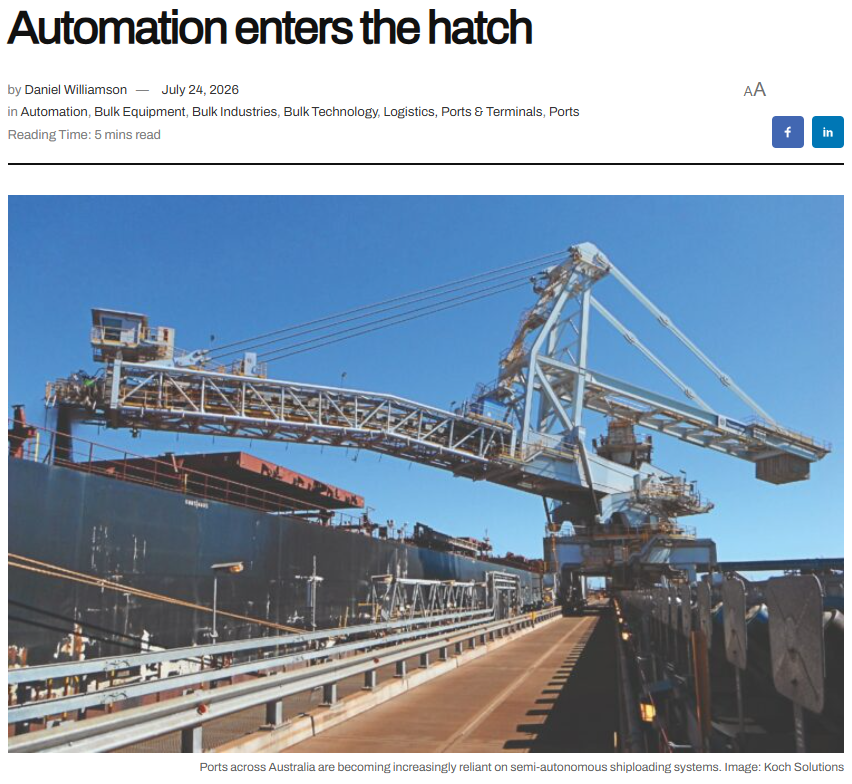
Koch Solutions head of sales Luke Bennett said many of Australia’s major export terminals are currently focused on sustaining throughput rather than significantly increasing it.
“Everyone’s still going strategically about it, ‘I’ve got so many tonnes going out the door, what infrastructure do I need to keep those tonnes going out the door?’,” Bennett told ABHR.
“No one seems to be adding any tonnes. It’s all about sustaining the tonnes going out the door and doing it more efficiently and more reliably.”
The trend is particularly evident across Australia’s bulk commodity ports, where operators are investing heavily in refurbishment and life-extension projects for existing assets.
Bennett pointed to several major shiploader projects currently underway across the country, including ongoing upgrades at in Newcastle, new shiploader procurement activities in Queensland and refurbishment programs in Western Australia.
However, something all these projects share is a specific, broader industry challenge: ageing infrastructure. A significant proportion of Australia’s bulk handling equipment was installed decades ago and remains central to export operations today.
Replacing these assets outright can involve substantial capital expenditure and downtime, making refurbishment and technological upgrades an increasingly sought after option.
One of the most significant developments emerging from these projects is the growing use of semi-autonomous shiploading systems.
Unlike stackers and reclaimers, which have largely transitioned to autonomous operation in many bulk handling facilities, shiploaders continue to require operators due to the complexity of loading directly into vessels.
Bennett said operators are increasingly being supported by sophisticated automation technologies designed to optimise performance.
“A lot of clients are starting to use automation when they’re loading a hatch,” he said.
“They have a hatch-loading programme that contains the optimum loading sequence. The operator positions the machine into the hatch and then the autonomy takes over and loads the hatch.”
The technology combines a range of sensors and monitoring systems, including high-definition cameras, infrared imaging, radar and laser scanning technologies.
Together, these systems create a detailed picture of the vessel and cargo hold, allowing software to determine the most efficient loading pattern.
“One operator might be smooth on the controls, and another operator might be a lot harsher,” Bennett said.
“Automation makes the operation consistent. Everything becomes quite standardised in how the machine is being used.”
For port operators, consistency translates directly into productivity.
Loading programs can optimise the filling of vessel hatches, reduce unnecessary machine movements and shorten vessel turnaround times. That can deliver meaningful commercial benefits.
“If you can turn vessels around quicker, you improve your tonnes out the door,” Bennett said.
“In some cases, operators can potentially increase outgoing capacity without needing major infrastructure expansions.”
Bennett said semi-autonomous operation can also play an important role in extending equipment life. By removing operator inconsistencies and reducing sudden or unnecessary machine movements, automated systems can reduce mechanical stresses placed on ageing equipment.
“If you’ve got an ageing machine, a way to alleviate potential unwanted stresses during operation is to have those operations done autonomously,” he said. “The machine is being operated in a more controlled and consistent way.”
This capability is becoming increasingly attractive as operators seek to maximise the value of existing infrastructure investments.
The technology is already being deployed at several Australian ports.
Many of the new shiploaders being requested from the industry are advanced hatch-loading automation, while similar systems are also being adopted at major iron ore export facilities in Western Australia.
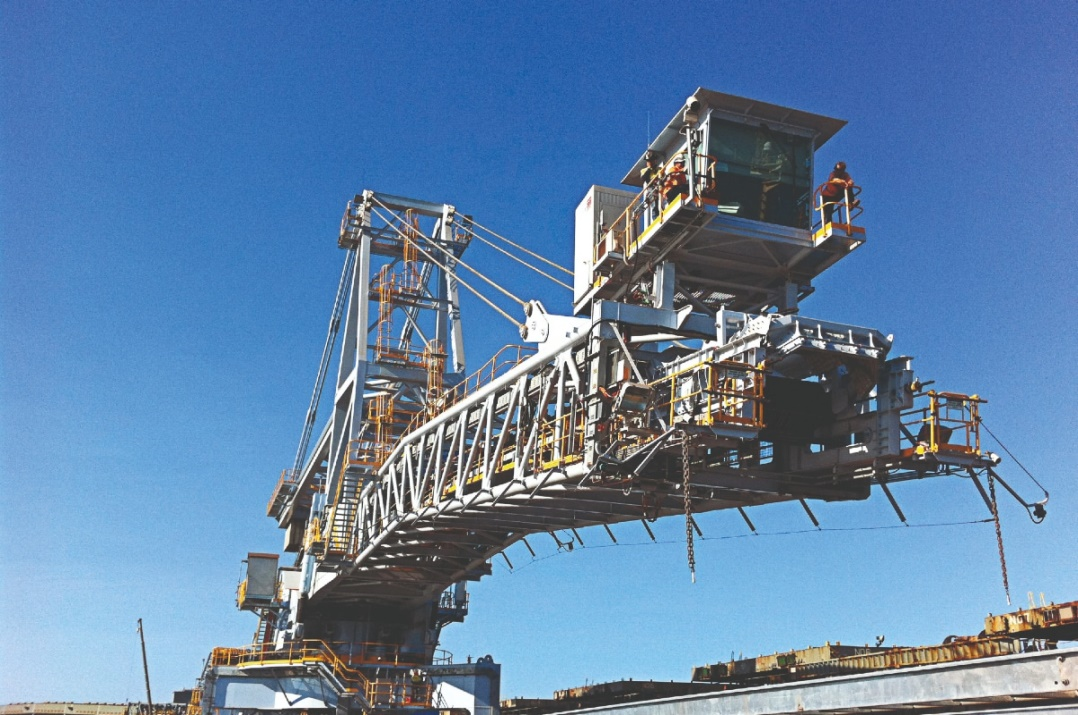
As the industry continues to balance rising throughput demands with ageing infrastructure challenges, automation appears set to play a growing role in Australian ports. For companies such as Koch Solutions, which specialise in the design, refurbishment and optimisation of bulk materials handling equipment, the shift represents an opportunity to combine traditional engineering expertise with emerging digital technologies.
“Our expertise is understanding how the entire machine functions as a system,” Bennett said.
“These machines aren’t just conveyors or chutes on wheels. Everything moves together and performs as a system.
“To successfully integrate these technologies, you need to understand how the whole machine works.”